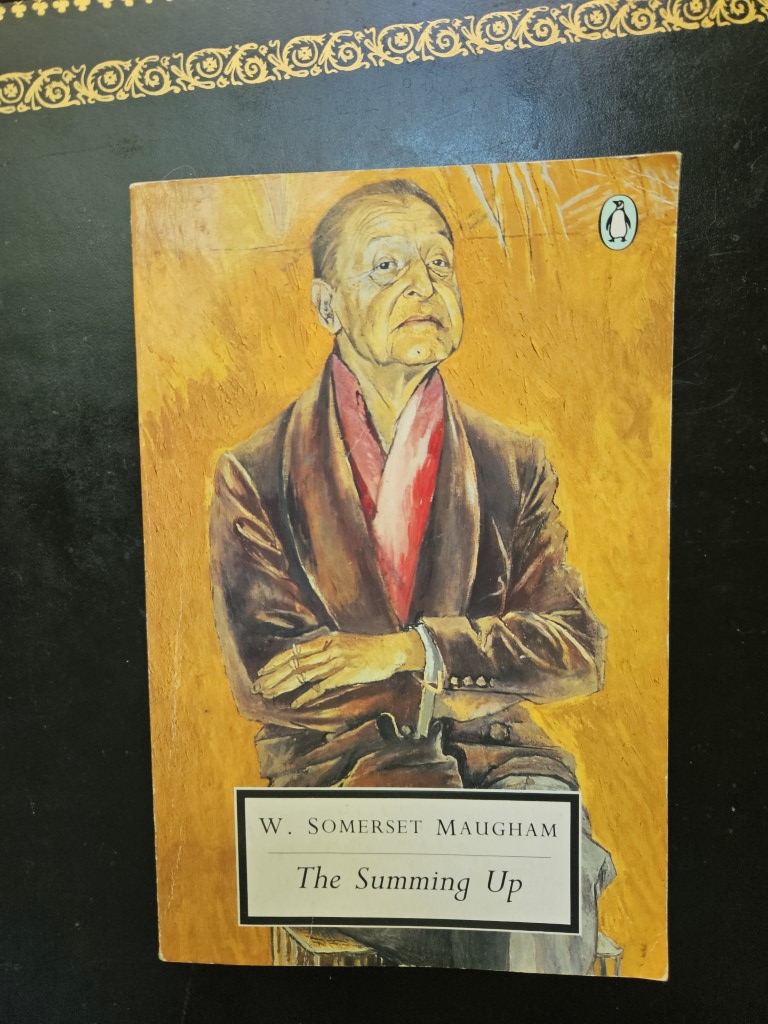
I first came across W. Somerset Maugham when I read his most famous work, Of Human Bondage (1915). It had been mentioned several times in pop culture that I was reading/watching at the time (including an episode of Buffy the Vampire Slayer of all places) and so I picked it up. While having nothing, so far as I could see, with a vampire fighting teenager, it was a great novel, leading me to more of his works. Most of the others I have not enjoyed anywhere nearly as much as Bondage but I recently finished The Summing Up, which is a reflection on his life and on art/writing in general. It has some great passages so I’ve compiled my favorites here.
(I occasionally do these posts after reading a book that I really enjoy. I never take these quotes from online and certainly never use AI in any way to compile them. I do it the old fashioned way, in order to get the most out of the words myself, rather than just as fodder for “content.”)
The Summing Up by W. Somerset Maugham (1938)
Page numbers from the Penguin Twentieth-Century Classics Edition
I have known in various countries a good many politicians who have attained high office. I have continued to be puzzled by what seemed to me the mediocrity of their minds. (6)
I have always wondered at the passion many people have to meet the celebrated. The prestige you acquire by being able to tell your friends that you know famous men proves only that you are yourself of small account. (7)
There is a sort of man who pays no attention to his good actions, but is tormented by his bad ones. This is the type that most often writes about himself. (11)
Everything I say is merely an opinion of my own. The reader can take it or leave it. If he has the patience to read what follows he will see that there is only one thing about which I’m certain, and this is that there is very little about which one can be certain. (12)
But to write was an instinct that seemed as natural to me as to breathe, and I did not stop to consider if I wrote well or badly. It was not till some years later that it dawned upon me that it was a delicate art that must be painfully acquired. (19)
But words are tyrannical things, they exist for their meanings, and if you will not pay attention to these, you cannot pay attention at all. (26)
Words have weight, sound, and appearance; it is only by considering these that you can write a sentence that is good to look at and good to listen to. (30)
I do not write as I want to; I write as I can. (30)
I do not think I am any better or any worse than most people, but I know that if I set down every action in my life and every thought that has crossed my mind the world would consider me a monster of depravity. (38)
Most persons, I think, are both exhilarated and rested by conversation; to me it has always been an effort. When I was young and stammered badly, to talk for long singularly exhausted me, and even now that I have to some extent cured myself, it is a strain. It is a relief to me when I can get away and read a book. (46)
Reverie is the groundwork of creative imagination; it is the privilege of the artist that with him it is not as with other men an escape from reality, but the means by which he accedes to it. (57)
To me reading is a rest as to other people conversation or a game of cards. It is more than that; it is a necessity, and if I am deprived of it for a little while I find myself as irritable as the addict deprived of his drug. (61)
The writer can only be fertile if he renews himself, and he can only renew himself if his soul is constantly enriched by fresh experience. There is no more fruitful source of this than the enchanting exploration of the great literatures of the past. (65)
Even the greatest authors have written a number of very poor books… The writer can rest assured that the books he would like to forget will be forgotten. (111)
With enough plain food to satisfy my small appetite, a room to myself, books from a public library, pens and paper, I should regret nothing. (115)
One must not expect too much of human nature and an occasional pot-boiler may be accepted from him with lenity. The writers who are in independent circumstances should sympathize with, rather than sneer at, those of their brethren whom hard necessity sometimes forces to do hack work. (116)
Every production of an artist should be the expression of an adventure of his soul. This is a counsel of perfection, and in an imperfect world a certain indulgence should be bestowed on the professional writer; but this surely is the aim he should keep before him. (121)
The artist produces for the liberation of his soul. It is his nature to create as it is the nature of water to run down hill. It is not for nothing that artists have called their works the children of their brains and likened the pains of production to the pains of childbirth. It is something like an organic thing that develops, not of course only in their brains, but in their hearts, their nerves, and their viscera, something that their creative instinct evolves out of the experiences of their soul and their body, and that at last becomes so oppressive that they must rid themselves of it. When this happens they enjoy a sense of liberation and for one delicious moment rest in peace. But unlike human mothers, they lose interest very soon in the child that is born. It is no longer a part of them. It has given them its satisfaction and now their souls are open to a new impregnation. (123)
The writer’s only safety is to find his satisfaction in his own performance. If he can realize that in the liberation of soul which his work has brought him and in the pleasure of shaping it in such a way as to satisfy to some extent at least his aesthetic sense, he is amply rewarded for his labors, he can afford to be indifferent to the outcome. (125)
For the disadvantages and dangers of the author’s calling are offset by an advantage so great as to make all its difficulties his appointments, and maybe hardships, and important. It gives him spiritual freedom. To him life is a tragedy and by his gift of creation he enjoys the catharsis, the purging of pity and terror, which Aristotle tells us is the object of art. For his sins and his follies, the unhappiness that befalls him, his unrequited love, his physical defects, illness, privatization, his hopes abandoned, his griefs, humiliations, everything is transformed by his power into material, and by writing it he can overcome it. Everything is grist to his mill, from the glimpse of a face in the street to a war that convulses the civilized world, from the scent of a rose to the death of a friend. Nothing befalls him that he cannot transmute into a stanza, a song, or story, and having done this be rid of it. The artist is the only free man. (125)
I think authors are unwise who do not read criticisms. It is salutary to train oneself to be no more affected by censure than my praise; for of course it is easy to shrug one’s shoulders when one finds oneself described as a genius, but not so easy to be unconcerned when one is treated as a nincompoop. The history of criticism is there to show that contemporary criticism is fallible. It is a nice point to decide how far the author should consider it and how far ignore it. (148)
But the point of the writer is that he is not one man but many. It is because he is many that he can create many, and the measure of his greatness is the number of selves that he comprises. (152)
The artist’s egoism is outrageous: it must be; he is by nature a solipist and the world exists only for him to exercise upon it his powers of creation. He partakes of life only with part of him and never feels the common emotions of men with his whole being, for however urgent the necessity he is an observer as well as an actor. It often makes him seem heartless. (152)
The artist is ill to live with. He can be perfectly sincere in his creative emotion, and yet there is someone else within him who is capable of cocking a snook at its exercise. He is not dependable. (153)
Sometimes the writer must ask himself whether what he has written has any value except to himself, and the question is perhaps urgent now in the world seems, at least to us who live in it, in such a condition of unrest and wretchedness as it has not often been in before. (153-4)
When the most eminent philosophers cannot always understand one another the layman may well feel resigned if he often does not understand them. (160)
Most writers have chills and fevers, aches and pains, nausea at times, when they are engaged in composition; and contrariwise they are aware to what morbid states of their body they owe many of their happiest inventions. Knowing that many of their deepest emotions, many of the reflections that seem to come straight from heaven, may be due to want of exercise or a sluggish liver, they can hardly fail to regard their spiritual experiences with a certain irony; which is all to the good, for thus they can manage and manipulate them. (172)
For my part I cannot believe in a God who is angry with me because I do not believe in him. I cannot believe in a God who is less tolerant than I. I cannot believe in a God who has neither humor nor common sense. (176)
The novelist constructs a public world out of his own private world and gives to the characters of his fancy a sensitiveness, a power of reflection, and an emotional capacity, which are peculiar to himself. Most people have little imagination, and they do not suffer from circumstances that to the imaginative would be unbearable. (186-7)
I do not know why distinctions are made between ancient art and modern art. There is nothing but art. Art is living. (199)
 Words will keep us together