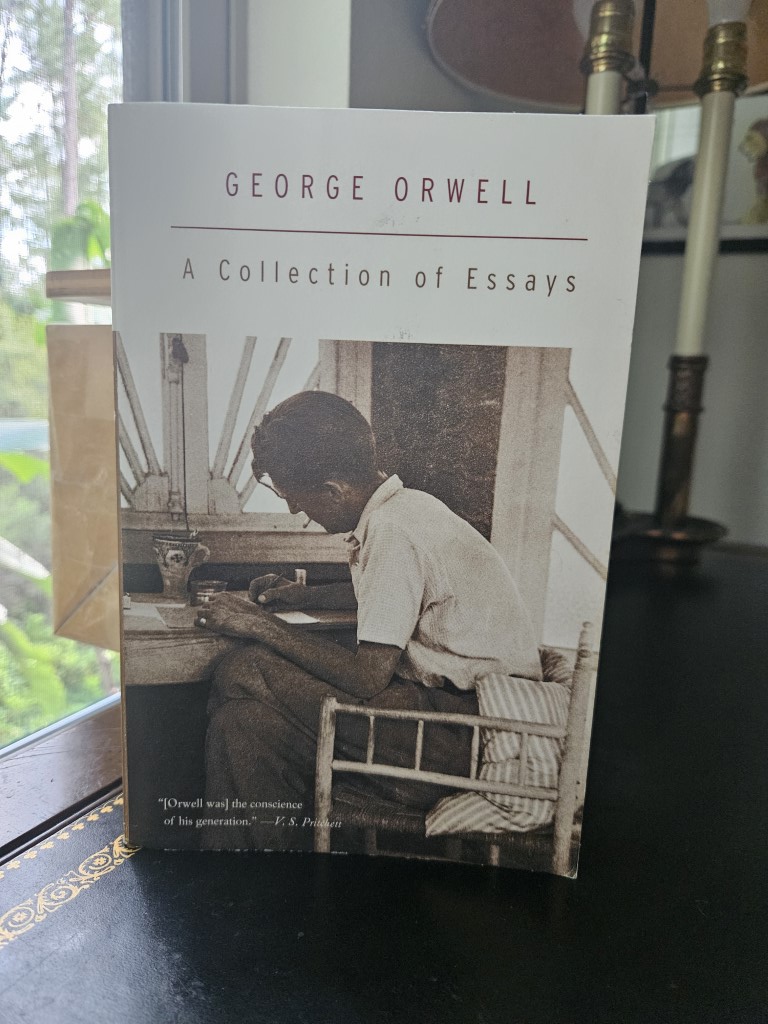
When I was in high school I started to collect quotes whenever I read a good book, it’s a habit I picked up from my U.S. History teacher, Mr. Graham. Every day he would go through his collection of quotes and write a meaningful one on the blackboard. The internet was in its infancy then and there was so Googling to find quotes. I’m sure I could write posts like this by doing that, but each one of these I came across in the book, underlined (with my special underlining pencil – what? you don’t have one?), then typed them all up in a document. Obviously this is much more work than Googling, but, like EVERYTHING, so much more meaningful than simply using the internet, and it affects my brain in such a different, more satisfying way.
Orwell, of course, is best known for 1984, (a book all Americans should definitely reread right now), but he was also a well known essayist. The following quotes are taken from A Collection of Essays by George Orwell (Harcourt). Some of these aged well, some not so much, and some didn’t mean a great deal to me as I wasn’t born English. Still, this was a great read overall and in many places when he was writing in the midst of WWII, you can simply substitute “MAGA” whenever he mentions fascism and it makes sense, sadly. Anyway, here are some of my favorite bits of his from this collection.
A Collection of Essays by George Orwell (1946)
Politics and the English Language (1946)
- It follows that any struggle against the abuse of language is a sentimental archaism, like preferring candles to electric light or hansom cabs to airplanes.
- [On the English language] It becomes ugly and inaccurate because our thoughts are foolish, but the slovenliness of our language makes it easier for us to have foolish thoughts. The point is that the process is reversible.
- As I have tried to show, modern writing at its worst does not consist in picking out words for the sake of their meaning and inventing images in order to make the meaning clear. It consists in gumming together long strips of words which have already been set in order by someone else and making the results presentable by sheer humbug. The attraction of this way of writing is that it is easy.
- In our age there is no such thing as ‘keeping out of politics.’ All issues are political issues, and politics itself is a mass of lies, evasions, folly, hatred and schizophrenia.
- Political language – and with variations this is true of all political parties, from Conservatives to Anarchists – is designed to make lies sound truthful and murder respectable, and to give an appearance of solidity to pure wind. One cannot change this all in a moment, but one can at least change one’s own habits…
Marrakesh (1939)
- All people who work with their hands are partly invisible, and the more important the work they do, the less visible they are.
Looking Back on the Spanish War (1943)
- Nazi theory indeed specifically denies that such a thing as “the truth” exists. There is, for instance, no such thing as “Science.” There is only “German Science,” “Jewish Science,” etc. The implied objective of this line of thought is a nightmare world in which the Leader, or some ruling clique, controls not only the future but the past. If the Leader says of such and such an event, “It never happened” – well, it never happened. If he says that two and two are five – well, two and two are five. This prospect frightens me much more than bombs – and after our experiences of the last few years that is not a frivolous statement.
Inside the Whale (1940)
- Good novels are not written by orthodoxy-sniffers, nor by people poor conscience-stricken about their own on orthodoxy. Good novels are written by people who are not frightened.
- The truth is that in 1917 there was nothing that a thinking and a sensitive person could do, except to remain human, if possible.
- But from now onwards the all-important fact for the creative writer is going to be that this is not a writer’s world. That does not mean that he cannot help to bring the new society into being, but he can take no part in that process as a writer. For as a writer he is a liberal, and what is happening is the destruction of liberalism.
Why I Write (1946)
- All writers are vain, selfish and lazy, and at the very bottom of their motives there lies a mystery. Writing a book is a horrible, exhausting struggle, like a long bout with some painful illness. One would never undertake such a thing if one were not driven on by some demon whom one can either resist nor understand.
- I think from the very start my literary ambitions were mixed up with the feeling of being isolated and undervalued. I knew that I had a facility with words and the power of facing unpleasant facts, and I felt that this created a sort of private world in which I could get my own back for my failure in everyday life.
- I think there are four great motives for writing, at any rate for writing prose. They exist in different degrees in every writer, and in any one writer the proportions will vary from time to time, according to the atmosphere in which he is living. They are: (1) Sheer egoism. (2) Esthetic enthusiasm. (3) Historical impulse. (4) Political purpose
- The opinion that art should have nothing to do with politics is itself a political attitude.
- So long as I remain alive and well I shall continue to feel strongly about prose style, to love the surface of the earth, and to take a pleasure in solid objects and scraps of useless information.
- I have not written a novel for seven years, but I hope to write another fairly soon. It is bound to be a failure, every book is a failure, but I do know with some clarity what kind of book I want to write.
 Words will keep us together