It’s the end of the year and while many bookish people are sharing their Goodreads year in review, I (despite using and enjoying that site) want absolutely nothing to do with that. America turns everything into a competition, a race to nowhere, and year end stats are just another symptom of that. If you read one book all year but it deeply changed your life, that’s endlessly better than if you’d read 50, 100, 1000 books in a year, but barely remember any of them within a month of now. So you read 9,000 pages this year – it doesn’t matter if you didn’t get much from them. I come to this post not to show off what I’m reading in any way, but to delve into it, as an examination for myself as much as any reader, but with the possibility that one or more of them may connect with someone out there.
It’s the end of the year and as most think about resolutions, I think we should think more about seeds – what seeds can you plant that will lead you toward your goals, toward a better life of deeper connection, value, and self worth? Focusing more on those seeds than any end goal will take you much further, and I try to see everything I read as a seed, even if that seed is as simple as a break from all the other things, so that I can come back to my main goals with some distance, seeing the forest for the trees, such as it work.
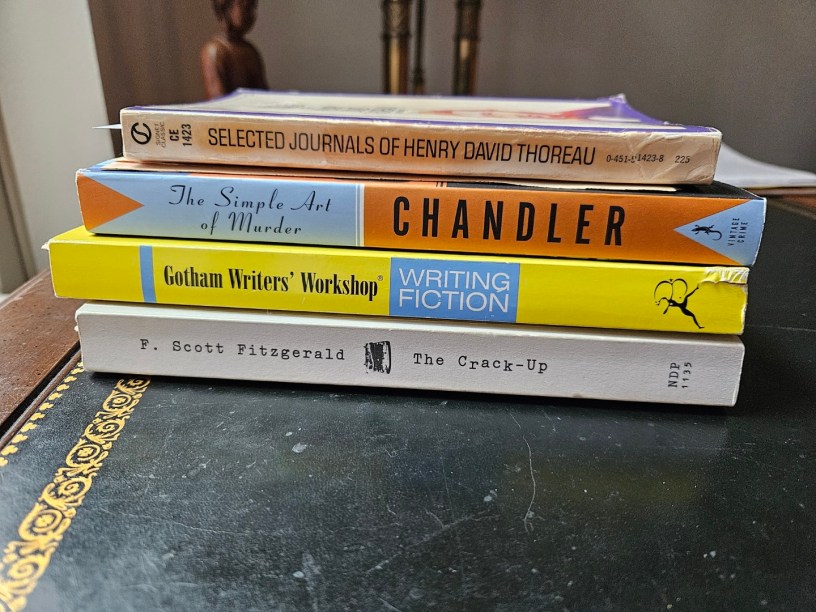
And so, here at the end of 2024, I have four books currently sitting on my desk, each in some sort of progress, as I no longer take one book and read it straight through. Each fulfills a purpose, and each is more suitable depending on my state of mind. In no particular order, I’ll just go from top to bottom.
Selections of Henry David Thoreau (1967)
In 1906 the notebooks of Thoreau were published and they filled 14 volumes. In the 1960s Carl Bode distilled these down to a single volume, which is what this is. Thoreau has been a favorite of mine ever since I first read him in high school, and I’ve continued to get more out of his work as I’ve aged. This book is ordered chronologically, so you can watch his talents/thought processes grow and develop. Many of the works he published during his life were drawn from these notebooks, and so what is left is a hodgepodge of some great stuff and some passages that are forgettable – in order words, a journal. I write a lot in my journal, but most of it isn’t very interesting and if I were ever to get famous there’d be little reason to publish it. Such is some of the work here, which is why I’ve moved so slowly through this work, but there’s still some wonderful passages. Thoreau must be read on real paper, and preferably in the outdoors. Worth a read if you’re already a big Thoreau fan. If not, just stick with the major works.
The Simple Art of Murder by Raymond Chandler (1950)
I rarely read any detective fiction (or genre fiction at all for that matter) but I picked this up at a library sale for a quarter and Chandler is the tops. This is a collection of his short fiction, and starts with an essay he wrote for The Atlantic in 1944, criticizing detective fiction in general, but also literature and society in general, and it is a great read. Beyond that I’ve only read the first short story, but it was enjoyable. For a man who didn’t start writing until he was 45, what a talent. And an inspiration to me at my age, who has yet to find a solid footing in the literary world.
Gotham Writers’ Workshop: Writing Fiction (2003)
Another book found at a library book sale. For years I thought raw passion and the desire to write was all one needed to produce amazing works. I hated being told how to do anything by “experts” and this certainly applied to my writing. Ah, what a young fool I was. While I still believe you can’t really teach good writing, per se, you can teach all the tools it takes, which was lacking in my own regard. This snotty teenager attitude held me back, but now I know I can always learn from others, even if it’s just what NOT to do. Three chapters in so far and I’ve already found many helpful suggestions in this book and would recommend it to any aspiring writer, or a old one that just needed a refresher. We can all benefit from going back to basics every now and again.
F. Scott Fitzgerald – The Crack Up: Edited by Edmund Wilson (1945)
Picked this one off the shelf a few months back when I was feeling really stuck. Fitzgerald was the reason I wanted to play with words in the first place and so I figured it was time to go back to the source of my inspiration. The essays here, written at his lowest point in his 30s, hit much, much harder now than when I first read them in my 20s. A hard life and struggle is something you can only really understand after going through it yourself. My dreams of being a young writer bursting out on the scene are long dead and buried, but the dream of writing isn’t dead and won’t be until I am. Parts of this book will likely only be of interest to Fitzgerald fans, but the essays themselves are a great read to anyone who enjoys good writing and can empathize with another’s struggles. As much as I love Hemingway, he condemned these essays and criticized Fitzgerald highly for them. I think he was completely wrong – what an outpouring of baring one’s soul on paper.
So that’s what I’m reading heading into the new year. It’s already clearly going to be a challenging year, what with the horrific decision made at the polls, but if each of us focused on the positive seeds we can plant within ourselves, it can be an amazing year. Cheers to everyone!
 Words will keep us together