“God, what a hell of a profession to be, a writer. One is one simply because one can’t help it.” – F. Scott Fitzgerald
“A writer not writing is practically a maniac within himself.” – F. Scott Fitzgerald
I always loved stories – both hearing and creating them – but it wasn’t until sophomore year of high school, when Mrs. Smith handed out copies of The Great Gatsby, that I realized what magic could come through language choice. One criticism of Gatsby is that it is little more than “a glorified anecdote,” and perhaps it is, but that misses out on the fact that much of it is more prose poetry rather than just straight prose. At this point, pretty much all stories have been told, what matters for anyone who loves literature is how they are told. For his command of language, Fitzgerald quickly became my favorite and has remained so for nearly three decades.
Because of this, for years most of my fiction reading consisted of hunting down every scrap that Fitzgerald ever wrote, as well as reading authors who were in his orbit. In an effort to expand my knowledge of literature in general, (which is what so many people told me I had to do – screw that), I’ve read many different authors the last decade or so, with a Fitzgerald story here and there, but they were the exception. With my recent struggles to create, I decided to go back to Fitzgerald, back to my original inspiration, but in a different way.
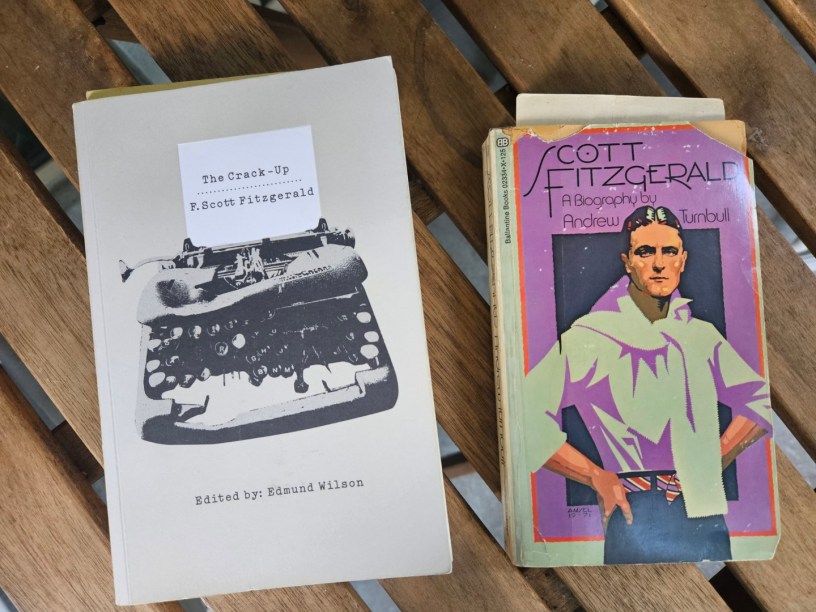
As Fitzgerald approached his 40s, he wrote his series of “Crack Up” essays for Esquire, delving into his personal failures and lack of creative output. Many at the time, including Hemingway, greatly criticized these efforts, but over time they have become considered to give great insight into what the world’s most famous writers, as well as helping to develop the personal essay as its own genre. I’ve read these several times before but now, with where I’m at at 42, they resonated on a deeper level for the first time. I’ve felt so many of the things that he describes, but his words naturally expressing any thoughts I’ve had in a much more coherent and powerful way.
Finishing these last night and knowing what and he came to just a few years afterwards, I then started to reread Andrew Turnbull’s great biography of Fitzgerald from 1962. Knowing that end, and then tracing everything that it took to get him there, I believe, will offer me new insights, both into his life as well as into to actions I can take to try to reinvigorate/reinvent myself, at least as far as creativity goes, gleaming lessons to be learned both in what he did and in what he didn’t do, in who and what he surrounded himself with.
Similar to Fitzgerald, I’ve lost any sense of the romantic that for so long was foundational to my life and identity, and I believe that’s why I’ve been such a mess for years now. Reality can never satisfy when you’ve spent countless hours drawing castles in the sky. Dreams are wonderful, but only in reality can anything tangible be achieved, and that’s something I’d like to do.
Since my first publication over 10 years ago, the literary/publication landscape has greatly changed, but so have I. I can no longer hold on to either what it was or what I was – not if I want to actually accomplish anything.
Now, let us go create.
What was the first thing you read that made you realize good storytelling is about so much more than just plot?
 Words will keep us together