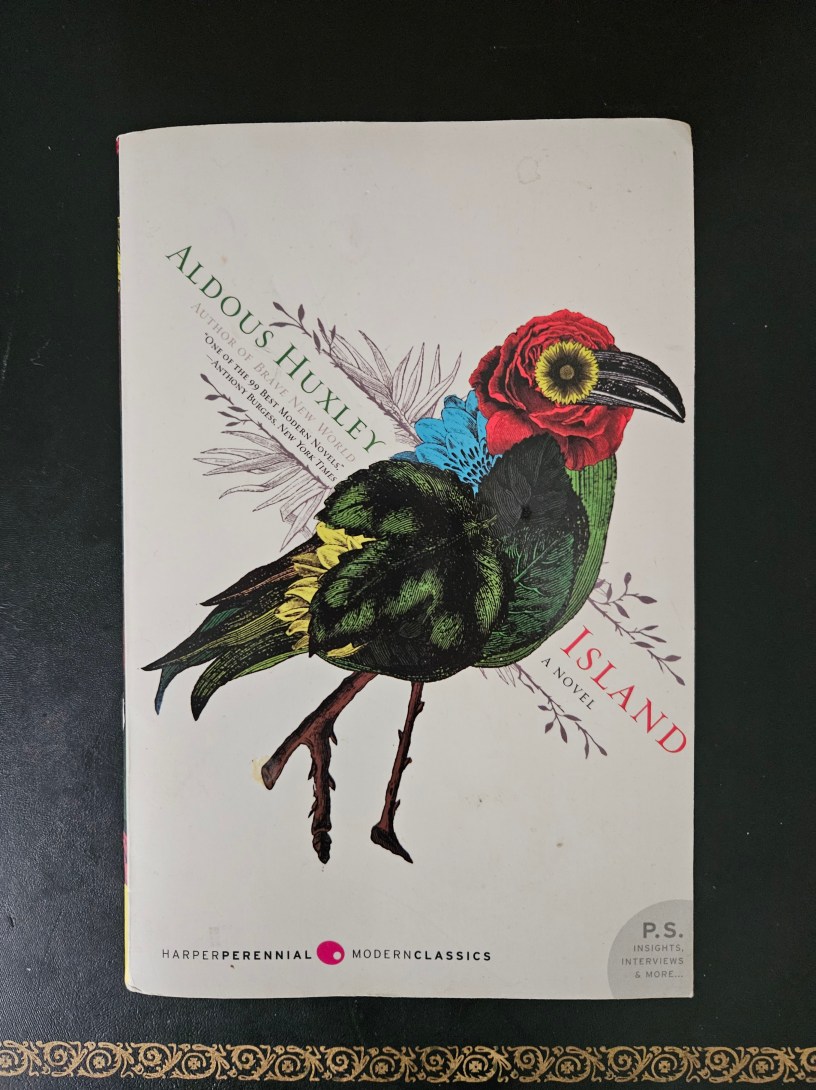
Nowadays, English writer Aldous Huxley is most well known for Brave New World (1932), his novel describing a scientific dystopian state, (which has seen many parts of it come true), and The Doors of Perception (1954), which became a sort of a Bible with the early psychedelic movement. However, he was extremely prolific during his lifetime, publishing some 50 books, including novels, nonfiction, essays, narratives and poetry.
His final novel, 1962’s Island, has been seen as a sort of counterpoint to Brave New World, exploring in detail what a utopia might look like in modern times. For this purpose he invents the island of Pala, where the residents have learned to live in peace, trained not to simply be good consumers, or to be good subjects of the state, but rather to seek to reach their highest potential as human beings. To take the reader on this journey we follow cynical journalist Will Farnaby, who is washed up on the island and subsequently becomes part of it.
This was the first time I’ve read this book and would highly recommend it. It is not so much plot heavy, although there is a plot of sorts, but rather more of an exploration of humanity, society and culture. For anyone like me who has read a lot of Eastern philosophy, particularly Buddhism, some of the passages can seem redundant, or to go on too long, but, I suppose, for those who have only known the Western canon/philosophy/religions, those passages could either be so foreign to be confusing, or incredibly eye-opening, depending on the person. There are a lot of great passages in this book, and so today I’d like to highlight some of the ones that stood out to me. (Page numbers are from the 2009 Harper Perennial Modern Classics paperback edition)
- “So you think our medicines pretty primitive?”
“That’s the wrong word. It isn’t primitive. It’s 50% terrific and 50% nonexistent. Marvelous antibiotics – but absolutely no methods for increasing resistance, so that antibiotics won’t be necessary. Fantastic operations – but when it comes to teaching people the way of going through life without having to be chopped up, absolutely nothing. And it’s the same all along the line. Alpha Plus for patching you up when you’ve started to fall apart; but Delta Minus for keeping you healthy. Apart from sewerage systems and synthetic vitamins, you don’t seem to do anything at all about prevention. And yet you’ve got a proverb: prevention is better than cure.”
“But cure,” said Will, “is so much more dramatic than prevention. And for the doctors it’s also a lot more profitable.” (Pg. 77) - “With nothing between the cortex and the buttocks,” said Dr. Robert. “Or rather with everything – but in a condition of complete unconsciousness and toxic stagnation. Western intellectuals are all sitting addicts. That’s why most of your are so repulsively unwholesome. In the past even a Duke had to do a lot of walking, even a moneylender, even a metaphysician. And when they weren’t using their legs, they were jogging about on horses. Whereas now, from the tycoon to his typist, from the logical positivist to the positive thinker, you spend nine tenths of your time on foam rubber. Spongy seats for spongy bottoms – at home, in the office, in cars and bars, in planes and trains and buses. No moving of legs, no struggles with distance and gravity – just lifts and planes and cars, just foam rubber and an eternity of sitting. The life force that used to find an outlet through striped muscle gets turned back on the viscera and the nervous system, and slowly destroys them.” (Pg. 173-4)
- “Which is better,” Will wondered aloud as he followed Vijaya through the dark Temple, out into the noonday glare, “which is better – to be born stupid into an intelligent society or intelligent into an insane one?” (Pg. 228)
- “But the fundamental question remains. What are boys and girls for?”
“Will shrugged his shoulders. “The answer depends on where you happen to be domiciled. For example, what are boys and girls for in America? Answer: for mass consumption. And the corollaries of mass consumption are mass communications, mass advertising, mass opiates in the form of television, meprobamate, positive thinking and cigarettes. And now that Europe has made the breakthrough into mass production, what will its boys and girls before? For mass consumption and all the rest – just like the boys and girls in America. Whereas in Russia there’s a different answer. Boys and girls are for strengthening the national state.” (Pg 247-8) - “Psychology, Mendelism, Evolution – your education seems be heavily biological,” said Will.
“It is,” Mr. Menon agreed. “Our primary emphasis isn’t on physics and chemistry; it’s on the sciences of life.”
“Is that a matter of principle?”
“Not entirely. It’s also a matter of convenience and economic necessity. We don’t have the money for large-scale research in physics and chemistry, and we don’t really have any practical need for that kind of research – no heavy industries to be made more competitive, no armaments to be made more diabolical, not the faintest desire to land on the backside of the moon. Only the modest ambition to live as fully human beings in harmony with the rest of life on this island at this latitude on this planet.” (Pg. 259) - Will laughed. “You’re an optimist.”
“An optimist,” said Mrs. Narayan, “for the simple reason that, if one tackles a problem intelligently and realistically the results are apt to be fairly good. This island justifies a certain optimism.” (Pg 272) - “You never saw anybody dying, and you never saw anyone having a baby. How did you get to know things?”
“In the school I went to,” he said, “we never got to know things, we only got to know words.”
The child looked up at him, shook her head and, lifting a small brown hand, significantly tapped her forehead. “Crazy,” she said. “Or were your teachers just stupid?”
Will laughed. “They were high-minded educators dedicated to mens sana in corpore sano and the maintenance of our sublime Western Tradition.” (Pg. 297)
I don’t want to have any spoilers, but I will say one of the best passages in the entire book is the end. If you enjoy the sort of thing conveyed by these handful of passages, I highly recommend picking up this book. It is sad just how much in this book remains relevant to our current situation, but it also highlights that, despite whatever the political situation is, we as individuals have enormous power over our own lives and how we choose to live them. Will you go through your life constantly consuming the endless bread and circuses fed to us, or will you balance those things with attempts to become a fully realized human being? The decision is all yours.
 Words will keep us together